
Labour excludes left candidates on any pretext. But supporting Narendra Modi is no problem?

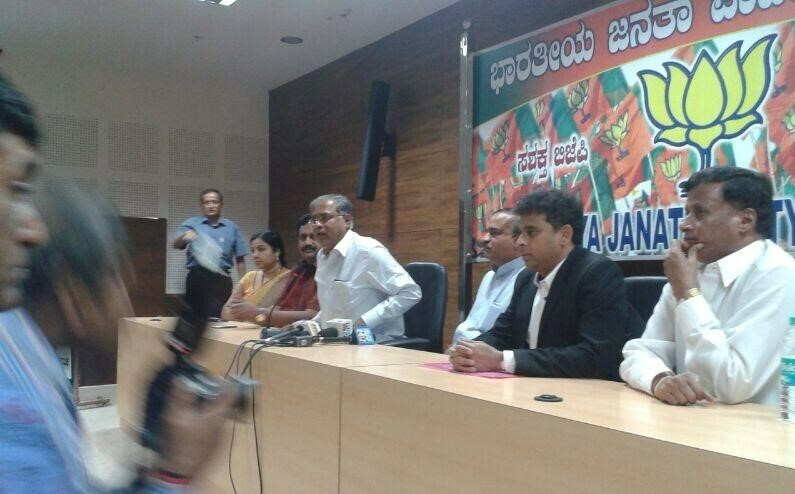
Neeraj Patil (in black jacket) joins the far-right BJP at a party press conference in Karnataka, 2014. Source of image: BJP Karnataka Twitter account

By Mohan Sen

In the Labour Party parliamentary selection in Camberwell & Peckham, South London, the left-wing candidate, black community activist, anti-racist campaigner and councillor Maurice Mcleod, was ruled out from standing – despite having support from trade unions as well as numerous party activists – on grounds including the fact he once liked a tweet by Green Party leader Caroline Lucas.

This is obviously outrageous in itself. It is part of a much wider problem, with left candidates excluded all over, often on the thinnest pretexts. In Kensington the former MP and leader of the Labour group on the council, Emma Dent Coad, was blocked from standing!

But in Camberwell and Peckham the party machine has added insult to injury – or rather severe injury to injury – by who it has included on the “long list” of accepted candidates.

The list includes right-winger Neeraj Patil, who was mayor of Lambeth (also South London) in 2010-11.

When we say Patil is right-wing, we do not mean he is on the more conservative wing of the Labour Party. We mean that since at least 2014 he has been an out-and-out right-winger, of an appalling kind.

In 2014, Patil travelled to India and joined the far-right (Hindu nationalist, Muslim-hating, ultra-neoliberal, worker-bashing) Bharatiya Janata Party (BJP), which was then about to come to power. The press conference at which the BJP announced this acquisition is pictured above (Patil is in the black blazer); the party tweeted about it here. It was also reported in the Indian media, eg here. Patil was photographed with BJP leader and Indian prime minister Narendra Modi in 2015 (see below). In 2017 he publicly campaigned for the BJP, telling the Indian media “I admire Prime Minister Narendra Modi”. More recently he has specialised in attacking any Labour support for the people of Kashmir.

Image
Celebrating Patil joining the BJP, 2014. Source: Twitter of BJP supporter “Kiran Kumar S”

Workers and oppressed minorities in India are under vicious assault by Modi’s BJP government and the far-right movement of which it is part – and meanwhile the Tories are fostering close links with the BJP and with the Hindu right in the UK, and pursuing a trade deal with India regardless of workers’ and human rights. That context should underscore why it is so outrageous that a BJP member could be allowed to stand to be a Labour MP.

Whatever wing of the Labour Party you are on, this should be utterly unacceptable. It is totally incompatible with the principles of equality, diversity and workers’ rights that Labour is supposed to stand for. It is an insult to all of us, and particularly to our Indian and Muslim-background Labour comrades – as well as our comrades in India.

Patil and Modi, 2015. Source: oneindia.com

Patil has been allowed to stand in Labour Party candidate selections before – and in fact in the snap election of 2017 he was, bizarrely, imposed as the Labour candidate in Putney (leading to a mass boycott by local party activists). It is high time we did something about this. Those who have licensed Patil to promote himself in the Labour Party, using his positions to support the far right in India, need to be called to account.

More widely it needs to be made clear that supporters of the BJP and Modi’s regime are not welcome in the UK labour movement. The Labour leadership must insist that anyone in the party with links to the BJP breaks them. We should be making solidarity with our sisters and brothers fighting for the rights of workers and oppressed groups in India, not those oppressing them.

• To do something positive about issues in India – solidarity with the Indian labour movement, left and oppressed people – see the India Labour Solidarity campaign, and put its model motion in your CLP or union branch.
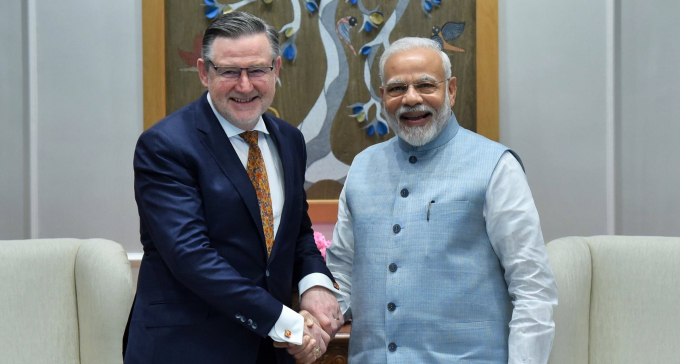
Neeraj Patil is part of a wider problem – eg Brent North MP Barry Gardiner, widely connected in the unions, is a supporter of Modi and the BJP government (pictured here with Modi). Source: nationalheraldindia.com

Model motion from India Labour Solidarity

Model motion from India Labour Solidarity
https://docs.google.com/forms/d/e/1FAIpQLSfMAz1oqhK14S6ftnzqVrLntwMJQwtpEjW1C0Jr5WYNWvPdWA/viewform
Support working people’s struggles in India!

Notes:
1. That India, the world’s second largest country, has extensive connections with the UK – including the Tories’ active support for its far-right BJP government.
2. The raging struggle between working people’s organisations and Indian capitalism’s economic and political elites, reinforced by right-wing Hindu nationalism, including during the 2020-21 farmers’ battle against the Modi government’s pro-corporate agricultural reforms.
3. That in 2020 India’s parliament passed sweeping new “labour codes” attacking workers’ rights even in the “formal” 20% of the economy where certain basic rights exist.
4. That this year’s Interational Trade Union Confederation Global Rights Index notes that working people protesting in India are regularly arrested, detained, tortured and murdered.

Believes:
1. That the Tories’ push to expand trade deals comes in the context of their indifference to attacks in India on human rights, workers’ rights, the rights of minorities, and basic civil liberties.
2. That while the UK Foreign Office is surreally praising India for its futuristic green vision, protests are surging against the London Science Museum’s funding by the India-based global Adani coal mining group, strongly backed by the Indian government.
3. That, in addition to the contribution of super-exploited labour in India to the UK economy, British firms working/trading in India are likely to learn from their Indian counterparts and lobby to further undermine workers’ rights here.

Welcomes:
1. The establishment of India Labour Solidarity (ILS), to promote solidarity with India’s workers’, working people’s and social justice movements in the UK Labour and trade union movements.

Resolves:
1. To invite India Labour Solidarity to speak.
2. To circulate information about working people’s struggles in India, and how they connect to workers’ struggles and interests here, to members.
3. To make a donation of £… to the Solidarity Fund ILS is establishing to support precarious workers’ organisations in India.

What happened at Labour conference 2022? An overview

• Read Labour Left Internationalists’ bulletins at Labour conference 2022 (24-28 September, Liverpool) here.

• At the conference the Starmer leadership largely got its way. The left in Constituency Labour Parties has fallen back significantly; but the decisive factor was a lack of stroppiness and political strategy from the union leaders.

• The impact of growing working-class struggle in the UK was visible in the conference, in that it did pass some quite good left-wing policies (see below), mainly from the unions – whose motions could not be bureaucratically carved out as many left-wing CLPs motions were. But the unions voted to passed left-wing motions and did little else to shake things up, despite numerous opportunities. Unless we shift things, the leadership will continue to ignore those policies.

• In advance of the conference, the unions did not challenge the expulsion and suspension of delegates, ruling out of motions, etc. In the conference itself, unions voted to avoid controversial issue areas, did not challenge manoeuvres to exclude demand that the leadership found inconvenient – notably public ownership of energy – and did not organise or back up challenges against ignoring of existing conference policy.

• More broadly, unions did little to “make a fuss” at the conference. To take one striking example: Liverpool dockers were on strike during the conference. Left activists and MPs went to their picket lines; but the Unite delegate did not organise a visit; and when the dockers came to the conference, far from mobilising people to join their protest, did not even join it themselves (or organise to take the dockers into the conference).

• The Labour left was weakened by demoralisation and by a wide range of bureaucratic stitch-ups, but the dominant forces on the left also lack strategy and drive. Momentum did little to get left-wing motions submitted or organise delegates. It actively discouraged protest when Starmer had the conference sing “God Save the King”, with the result that there was almost none (LLI protest in its main bulletin and to the best of our ability on conference floor).

• You can read all the motions submitted and the composite motions passed here.

• Some of the text unions put to the conference was typically vague, but some of it was quite clear. The conference voted for:
– Pay rises at least in-line with inflation.
– “Unequivocal support to all UK workers taking strike action” and for joining picket lines, including “all Labour MPs” doing so
– A £15 minimum wage
– Opposing privatisation, academisation and outsourcing; bringing services back in house; public ownership of the railways and Royal Mail specifically and of “essential services and utilities” generally (to give credit where due, that last phrase was from Unite)
– A free, publicly funded and publicly provided social care system
– “Proper needs-based funding for local government”, ie an implication of reversing the cuts
– “To return all privatised portions of the NHS to public control”
This builds on left-wing policies passed in 2021, including public ownership of energy and repeal of all anti-union laws. The issue is the weakness of campaigning for these policies and to demand Labour commits to them.
With motions for public ownership of energy and the broader Labour for a Green New Deal kept off the agenda, the composite passed on climate change was extremely bland. Ditto the composite on childcare.

• The conference voted overwhelmingly for strong solidarity with Ukraine, but the composite unfortunately included right-wing CLP’s support for NATO and GMB’s for higher UK “defence” spending. It also dropped the positive proposals for actually mobilising members put forward in the National Union of Mineworkers motion.

• Unlike last year, when the unions voted down a CLP majority for proportional representation, this year both sections of the conference voted for, along with a call to abolish the House of Lords. We should push forward these demands as part of a wider programme to defend and extend democracy, while not treating PR as some kind of panacea or opposing Labour entering coalitions with parties to its right.

• There were no motions on Brexit, on policing and criminal justice, or on international issues except Ukraine.

• The leadership showed some small shifts to the left, with promises or nods on a publicly owned energy company, more council housing, tenants’ rights, nationalising the railways, insourcing and workers’ rights, among other things. However Starmer also pitched to the nationalist right (quite explicitly in fact) by promising a “points-based immigration system”. The leftish policies the leadership did put forward are extremely limited even compared to the Corbyn years, and without much greater pressure and the establishment of some degree of accountability over the leadership, they will surely be watered down, not firmed up.

• Leadership spokespeople said nothing to support strikes or about repealing anti-strike laws, except Angela Rayner saying Labour would reverse any new ones Liz Truss brings in.

• Corporate lobbyists and the like were a greatly increased presence at the conference. The media reports Keir Starmer and Rachel Reeves have had 250 meetings with CEOs.

• In addition to distributing our bulletins, Labour Left Internationalists helped organise fights on conference floor and in compositing; mobilised people to support the dockers; also supported trans rights and anti-racist protests outside the conference; and worked with organisations including the Labour Campaign for Free Movement, Free Our Unions and the Ukraine Solidarity Campaign to promote their events at the conference.

• With Labour now high in the polls, the Labour right will be triumphant. The socialist left should not be intimidated, but step up our work to promote class-struggle, internationalist policies and campaigns in Labour, seeking to pull as much as possible of the wider labour movement into this fight.

Documents with text of motions, information about votes, etc at Labour conference 2022

And the Campaign for Labour Party Democracy’s record of decisions:

https://labourleftint.uk/wp-content/uploads/2024/10/1544b-record_of_decisions_2022_clpd_.pdf

And all the motions which were originally submitted to the conference (before prioritisation of certain topics, and compositing):

https://labourleftint.uk/wp-content/uploads/2024/10/03379-labour-conference-motions-compressed.pdf

Motion on Labour Party ban, for affiliated union branches and for LP branches and CLPs

The motion below was passed by Islington South and Finsbury CLP on 21/9/22. In other CLPs or union branches it may be most expedient just to move the first two paragraphs.

We call on the National Executive to reverse the ban imposed on Workers’ Liberty by the Labour Party National Executive on 29 March 2022, and to reverse all suspensions or expulsions of members under the ban.

The Labour Party will be better able to defeat the Tories if we organise as a broad church, with disciplinary action only after due process and for specific harmful actions

The terms of this particular ban flout natural justice, for example:

• Members are made subject to exclusion for actions such as giving interviews to a newspaper or attending a meeting years ago, when such actions were commonplace, with no indication that they broke Labour Party rules

• Members are exempted from the risk of exclusion if they attend a meeting to debate. This is a welcome exemption. But logically this exemption should apply to all those who attend the meetings (the essence of which is debate).

Two Labour Left Internationalists broadsheets for Labour conference 2022

We have produced two four-page broadsheets for distribution at Labour Party conference (24-8 September, Liverpool). The first is a general one on a wide range of issues; the second is focused on energy and the cost-of-living crisis.

You can download both below, and we’ll be giving out physical copies in Liverpool. (To contact at the conference: 07775 763 750)

We may also produce regular smaller bulletins in response to developments at the conference.