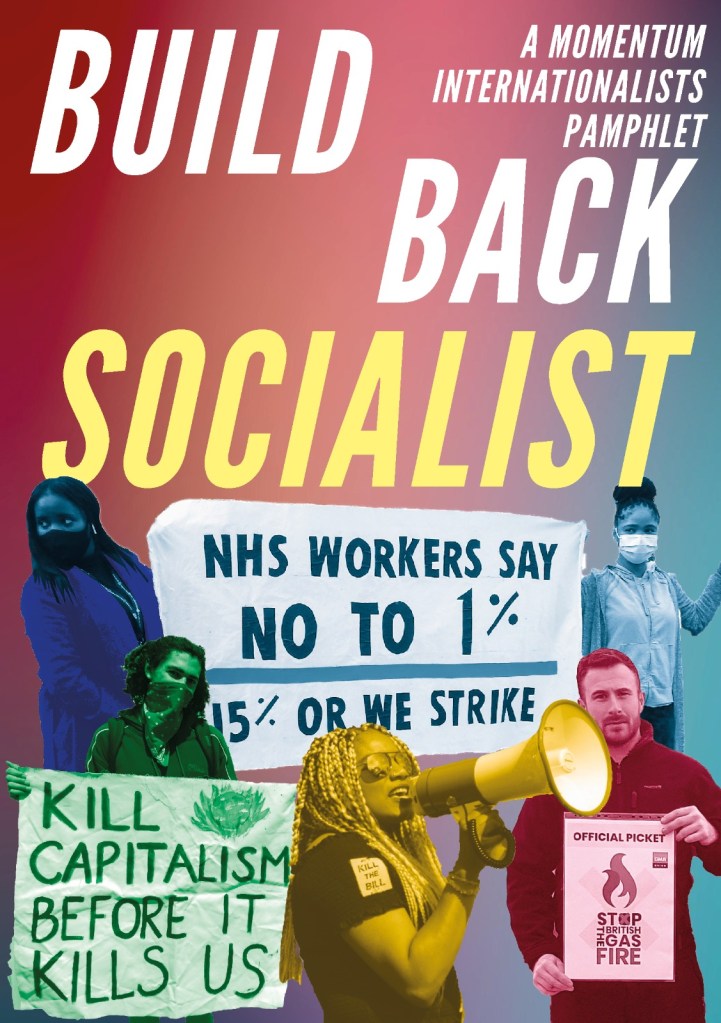
Venezuela: against imperialism and Maduro!

By Dan Davison

Recently, the Democratic Socialists of America International Committee (DSA IC) sent a delegation to Caracas, Venezuela. From 21 June to 1 July, they attended the Bicentennial Congress of the Peoples and related events. The Congress was essentially a propaganda tool for the Venezuelan government. It was launched by President Nicolás Maduro himself and one of its explicit objectives was “to express support for the Bolivarian Revolution”.

There is certainly a pressing need for international solidarity with the Venezuelan working class. Economic and political crises have left the country in a dire state. The minimum monthly wage is now 10 million bolívares, which at the current exchange rate is the equivalent of only 3.54 USD. The Covid-19 testing and vaccination rate has been slow, and the government has misreported the death toll: as of 14 June, they registered only 2,764 deaths, but have been routinely omitting patients who were not tested or whose results did not arrive on time. 

Widespread malnutrition and a collapsing healthcare system have increased infant mortality and deaths in childbirth. Gang warfare has escalated in Caracas neighbourhoods, with the police and military so miserably failing to reestablish control that they showed false photographs of confiscated weapons that were actually taken in Bolivia. More than 6 million Venezuelans have fled the country since Maduro took office in 2013.

However, the DSA IC’s understanding of “solidarity with the Venezuelan working class” is “support for the Venezuelan government”. Sometimes this is based on the Maduro regime’s ostensible socialism; other times it is purely negative anti-imperialism (i.e., “Maduro is against American imperialism, ergo we should back Maduro”. I have heard at least one person analogise the situation to critically supporting a bureaucratic trade union against the bosses. Perhaps intentionally, this is the exact analogy that certain orthodox Trotskyists used for the Stalinist USSR in the 1940s. The problem with this analogy is its implication that, like a bureaucratic trade union, the Maduro regime is in fact fighting for working-class interests, just in a flawed and conservative manner. 

However much the ruling United Socialist Party of Venezuela (PSUV) positions itself as pro-worker and blames the country’s ills on American imperialism, the Maduro government systematically attacks the working class and is itself backed by imperialist powers like Russia and China. It has introduced austerity measures like the Ministry of Work’s Memorandum 2792, which undermines collective bargaining agreements. It invites transnational corporations to engage in harmful mining operations in Venezuela’s Amazon region. It keeps a Mafia-like grip on the unions and persecutes labour activists like Rodney Álvarez, who was recently sentenced to 15 years in prison.

Orlando Chirino, an independent socialist and trade union activist with the Venezuelan left-oppositionist Party for Socialism and Liberty, astutely puts it as follows in an open letter to DSA:

“In Venezuela we are fighting against an anti-worker and anti-popular capitalist government, authoritarian, conservative, repressive, that hides the repression and the anti-worker and anti-popular adjustment that it applies, under a ‘socialist’ pseudo-discourse, and as it’s not aligned with the US, it’s perceived by some as ‘Anti-imperialist’, and supported by sectors of the US and European left. This scheme repeats the typical mistakes of the cold war in the 20th century. The true internationalist must always support the struggles of workers and peoples for their liberation, beyond national borders.”
In short, I urge comrades in DSA and elsewhere on the international left to support the Venezuelan working class against the attacks it faces from imperialist powers and the Maduro regime alike. For example, Labour Party and trade union branches should perform actions in solidarity with left-wing political prisoners in Venezuela like Álvarez whilst also pushing back against right-wing calls for intervention. I also recommend following Venezuelan Workers Solidarity, a group of Venezuelan socialists in the US that rejects crude campism, as well the Venezuelan Voices blog, which provides helpful analysis from a critical left perspective.

Cuba: lift the embargo, end the repression!

By Dan Davison

In recent weeks, large-scale protests have erupted on the streets of Cuba. Their main (and, in my view, ill-advised) slogan is “Patria y vida”, meaning “Homeland and life”. The catalyst of these demonstrations is the Cuban government’s handling of the economic crisis and the Covid-19 pandemic. Working-class Cubans face high inflation and major shortages in food, medicine, and power supplies. Longer-term causes of the unrest include the crisis of legitimacy the Castroist regime has increasingly faced since Fidel Castro’s death in 2016.

The response of much of the international left has been to exclusively or near-exclusively blame these material hardships on the USA’s 60-year embargo on Cuba, as well as more recent US sanctions. For instance, a statement from the Socialist Campaign Group (SCG) of UK Labour MPs correctly opposes foreign intervention and calls on President Biden to suspend US sanctions, but causally attributes the “real suffering [of] the Cuban people” only to the US blockade, the Trump Administration’s wave of sanctions, and the pandemic. It does not engage with any of the protesters’ political demands against state repression and in effect washes the Cuban government’s hands of all responsibility for the crisis.

Certainly, Cuba’s history with the US is highly relevant. The US dominated Cuba before the Cuban Revolution of 1953-59 and then attempted to reassert its de facto control over the island by financing and directing a landing force of Cuban exiles in the disastrous 1961 Bay of Pigs Invasion. Respecting consistent democracy has to include support for Cuban freedom from such imperialist predation. As such, the left and the labour movement should strongly push back against calls for the US or other powers to step in.

At the same time, respecting consistent democracy requires one to support the Cubans’ own demands for democratic rights. Although much of the left sees Cuba as either socialist or in transition to socialism, the truth is that Cuba is a class society where a privileged bureaucracy exploits and represses the working class it claims to represent. Workers in Cuba have even fewer political freedoms than they have in bourgeois-liberal democracies. They have no free elections and are not allowed to form independent trade unions.

To dismiss this lack of political freedoms by pointing to Cuba’s nationalised property and successes in social programmes is to forget that the socialist cause is (or at least is supposed to be) about extending democracy. Simply put, without democratic freedoms, there can be no socialism. It also ignores how the regime has arrested such dissident left-wingers as the Cuban Marxist scholar and activist Frank García Hernández and clamped down on demonstrations for LGBT rights and against racism. Consistent socialists would condemn such repressive acts when capitalist states commit them and that should not change simply because the Cuban state drapes itself in red.

A socialist response to the crisis in Cuba should include, among other things, a sliding scale of wages, independent trade unions, and concrete measures for democracy and against corruption. To be sure, many of the protesters will favour a more “free market” solution. This is unsurprising given how much the decades of “actually existing socialism” have discredited socialism in people’s eyes. Nevertheless, the political duty of the international left is to support Cuban workers against both foreign imperialism and their domestic regime and to help the left-wing currents within the protests win out against the right-wing currents.

Momentum’s refounding process: Two proposals

Momentum has now launched its long-awaited refounding process, and a debate should now open up about the future of the organisation.

While we don’t expect Momentum to become perfect through this (rather labyrinthine and heavily filtered) process, we do welcome the fact that it is happening. This is a real opportunity to build a better left. 

The overriding priority for Momentum in the coming years must be the regrowing of a dynamic, outward facing grassroots infrastructure – in the form of local groups and a network of activists in trade unions and communities – and a democratic system which allows that grassroots to thrive and puts it in charge of what the organisation does. At the moment, Momentum is little more than a leftwing NGO – highly centralised and dominated by the office – and that must change. 

Here are our top two proposals for the Refounding Process. If you agree with them, submit them either to your local group or the process directly – and let us know at [email].

1. Regional networks

One of the most important aspects of renewing Momentum is about giving members and local groups the opportunity to coordinate horizontally with one another in their areas, without constantly having to go through the office. This makes for better, more dynamic campaigning activities and helps new groups develop by giving lay activists the opportunity to lead local group development in their region. 

It is also essential that, as the grassroots rebuilds, it has representation at a national level. No one on the NCG is currently accountable in any meaningful way to Momentum members: they are elected every two years and then do whatever they want. Having people elected more regularly from a defined local conference to which they must report and be accountable will create a direct link between the grassroots and the leadership. 

We are therefore proposing that in each Labour Party region (or a similar set of boundaries drawn up by the NCG) there are regional networks which:

  • Hold a conference twice per year which is open to all members in that region (i.e. which is not delegate-based).
  • Have autonomy to run campaigns, coordinate and communicate with members and supporters in their region.
  • Have the ability to set up their own Steering Committee (however informal) to help coordinate.
  • Elect representation on the NCG equal to the number of NCG members elected online. These elections should happen at the all-member conferences, and representatives should be accountable to members in their region. 

2. A sovereign annual conference

What is Momentum’s policy? Who decides it? How do you change the constitution? At present, things are basically run by the NCG, with an occasional – and it really is very occasional – plebiscite in which there is no proper deliberation and the centre of the organisation can endlessly manipulate the process. 

Every single organisation in the labour movement – every union, most factions and the party itself – has an annual conference, and there is a reason for this. Having a conference, with delegates representing local groups and others representing members who don’t have a local group, is a crucial mechanism for putting the grassroots back in charge. It can also be an annual focal point for Momentum, with a big events fringe, and could be open to any member to attend and observe. This doesn’t have to replace other forms of democracy, but it is a basic part of having a thriving activist organisation. 

At the moment, Momentum’s grassroots are so weak (and there are so few local groups) that it would be almost impossible to hold a sizeable conference, so we aren’t proposing holding one immediately. But it must be a priority. The drive for democratisation should work alongside the drive to rebuild local groups. 

Labour: Build Back Fairer! An organising meeting by Zoom for Labour conference 2021, Monday 28 June

Register at
https://us02web.zoom.us/meeting/register/tZUpcemspzMqHdy2MXlaBGJ3ulGw8cKklvUA?fbclid=IwAR3GLtoTjredPOAQctpibKJl4ustAxKbTqTDASSpymGgJhqX2p38Km6zoJQ

Join Stevenage and Southampton Momentum on 28th June at 7:30pm in discussing the “Build Back Fairer” motion, passed by Stevenage Momentum and now supported by the national Momentum organisation for Labour Party Conference 2021. This joint meeting will be held on Zoom.This pandemic has shown that inequality in society can have serious, deadly consequences for everyone.After the worst of the pandemic eases off, we face the risk of another round of disaster capitalism and cronyism like that which followed 2008. We need an alternative plan to rebuild!Labour needs a bold plan to rebuild society on a better, safer, more equal basis after the pandemic. We are likely to face serious economic turmoil, with many people losing their homes and livelihoods. Determined action by Labour, the trade unions, communities and government is needed to create a society which is liveable and fair for the survivors of the pandemic.

https://www.facebook.com/events/s/labour-build-back-fairer/3945202035534425/

“Refounding Momentum”: confusing, trendy, disempowering

By Michael Elms

But better than nothing!

The Momentum leadership has set up a process for re-writing the Momentum constitution. It will revolve around “Momentum Assemblies” filtering and re-writing submissions from members and local groups. That there will be any kind of collective input into the new constitution is a step forward. And the intentions of the leadership are surely good.

But the rules for how this system will work are complicated and disempowering, and they replicate the culture of top-down paranoia about local groups that has stymied Momentum organising for years. You can read the rules here.

Looking back five years

In the announcement of the “Refounding Momentum” process, the Momentum leaders write:

“At certain points every organisation needs to change, and Momentum does too. After five years of rapid growth and many successes, and following the 2019 General Election defeat, now is the time to rebuild our organisation from the ground up.”

But if we’ve had five years of growth, why does Momentum need rebuilding? In fact, unfortunately, Momentum has fallen apart in the last couple of years. It retains tens of thousands of members on email lists, but the life of many of Momentum’s local groups has dwindled. Obviously, the Labour left was badly demoralised by the 2019 election defeat, and the pandemic has made local meetings more difficult. But the falling-away of local groups began well before 2019.

A major factor in that dwindling was that from January 2017, Momentum became intensely centralised. Before 2017, lots of local groups had come together and elected delegates to go and make decisions at regional and national meetings. But in order to impose “message discipline”, and to insulate the Labour and trade union leaderships against leftwing grassroots pressure, Momentum was suddenly reorganised from the top down, in a January 2017 “coup” which the Clarion described in detail here.

This change was about taking power and initiative away from local groups. It became hard for local groups to access their own data, and almost impossible for local groups to submit motions or propose policy changes. Before January 2017 Momentum had been at least theoretically governed by meetings of delegates representing vibrant local Momentum groups (though in fact many meeting decisions were blocked by the office not even communicating them to the general membership, let alone pushing them publicly).

Now the message was: “Momentum’s local groups can’t be trusted with running things. The staff at the office – the grown-ups – are in charge now”. All democratic engagement under the new system was for members as individuals, centrally administered by the office staff, with no role for local groups. A ridiculous system of “regions” was set up for NCG elections: the boundaries had obviously been gerrymandered in order to produce convenient results for the incumbent leadership. A “Members’ Council” of randomly-selected members was supposed to meet up and generate suggestions for the NCG.

When it met, the suggestions it made were not to the NCG’s liking. At least one of its randomly-selected members was phoned up and threatened with expulsion if they turned up again, and the “Members’ Council” never met a second time.

In short, a very big reason for local Momentum groups dropping off (and Labour leftwingers often re-organising themselves outside Momentum in ward and CLP “left caucuses”) is because people aren’t stupid and they can tell when they are being patronised and silenced. Why bother trying to engage with a structure that’s made it clear that it doesn’t want to hear from you? The whole philosophy of the new structure was to dissolve local organisation into a passive, atomised membership which would respond to instructions sent out from the centre by SMS or email.

It is good, and overdue, that Momentum is organising a democratic process to re-write its constitution. One basic remedy for the organisation’s problems is to hand back power to local groups. But empowering local groups means allowing them to come up with ideas that you might not have vetted in advance! It means accepting a loss of control.

Unfortunately, the procedure that the Momentum leadership has come up with for the refounding process is confusing and disempowering. This system will have the effect of filtering out any new or controversial ideas that local groups might come up with. The system of “Momentum Assemblies” will keep power and initiative in the hands of the national leadership, not the membership.

Compositing is good, actually

In this “refounding” process, “Momentum Assemblies” are supposed to play the role that “compositing” plays in the democracy of the Labour Party and many other labour movement bodies. But this newly-invented system is not as good as compositing.

A central idea in compositing is the idea that if your local branch (of Labour, trade union, or whatever) passes a motion, it gets to have ownership of it. That means that you, as a local group, get to be the ones to advocate for the motion (because it’s your idea!); and because it belongs to you, only you can decide whether or not to scrap bits of it.

Let’s say many similar motions come into a conference. They all call for electoral reform, so they are all being composited into one motion. But one of these motions also calls for abolishing the monarchy. The proposers of all the other motions say, “abolishing the monarchy doesn’t fit with the spirit of what we are saying. We don’t want this line to go into our shared motion”. The people who have brought the lone, controversial abolish-the-monarchy motion don’t have to bin their idea just because they are in a minority. They can say “OK, this is too controversial for the main motion. But we still think it is important, and we want conference to vote on this idea separately from everything else”.

That separate vote on a single line might be a faff. But the principle behind it is important. Having ownership of your text is a good way of making sure that even controversial ideas have a right to be heard. After all, “freedom must mean freedom for the one who thinks differently”. In the jargon of Labour Party conference, taking out a line to be voted on separately in this way is often called creating a “split composite”.

But under the Refounding Momentum procedure the idea of local groups having ownership of their own ideas goes out the window. The Momentum Assemblies won’t work like normal compositing. There will be nothing to stop them from just chopping out controversial or complicated ideas. In fact, whereas compositing is supposed to be about organising motions to get a hearing for everyone’s ideas, these “Assemblies” will act as a filter on controversial, awkward or minority ideas.

Why’s that? “Consensus decision making”; and lack of representation for local groups.

Consensus decision making cuts out controversy

In normal labour movement democracy, there is a contest between proposals which are written down clearly. If someone wants to put an amendment, they have to write it down so that everyone can see exactly what they’re talking about.

With consensus decision-making, the emphasis is on chiselling and re-shaping proposals in a constant process of adjustment and compromise. The objective is to round off all the sharp edges so there doesn’t have to be a vote-out between opposing visions. Normally, it is the job of the facilitator to interpret and summarise all the little adjustments and shifts along the way. What’s more, this is generally done verbally, and not by way of written amendments.

This means much less clarity. It relies much more on how the facilitator chooses to interpret and remember the things that are said. It creates much greater pressure to drop controversial stuff. A charismatic, or forceful, facilitator can easily override hesitant delegates, especially ones who are in a minority – especially in an improvised system where everyone’s rights over their text and ideas aren’t written down properly.

In Momentum’s proposed “consensus decision making” version of compositing, what would happen to a controversial idea, like abolishing the monarchy, as per our example above? In a consensus system, the facilitator’s job is to avoid a sharp up-down vote-out or a “split composite”. So a facilitator might “create consensus” by persuading supporters of the controversial text to re-word it until it was almost meaningless. If most of our supporters of electoral reform won’t accept the call for a Republic, maybe they would accept “steps to investigate deepening democracy including examining the role of the monarchy…” or similarly opaque blather. But it would mean that in the interests of “consensus”, an important minority viewpoint has been deleted, without anyone really admitting that it has been deleted.

Consensus decision making tends to produce fudges. In a constitution, that can be dangerous. People will come to the table with ideas of different systems. Better to choose one or another system, rather than compromise on a stitched-together mishmash of mutually incompatible ideas. That is a recipe for a constitution that can’t actually work as it is written down on the page.

And let’s remember – all of this complicated consensus process of negotiation and minute adjustments is supposed to be taking place over Zoom!

Local groups written out

The “Momentum Assemblies” will be made up of four members of the NCG and four representatives of affiliate groups. There will be eight representatives of local groups… so long as there is “room” for them! If there isn’t enough “space” (on a Zoom call?) for all the representatives of local groups, then eight of them will be selected at random. Note that it’s the local groups whose numbers are limited and who have to get selected at random: not the NCG members or representatives of affiliates. This rule is very weird and makes it clear that local groups are less important than the national leadership or invitees from external organisations.

The “randomise local groups’ reps” rule means that if your group sends in some text for the process, there is no guarantee that you’ll be able to choose someone to go and advocate for that text and make sure your local group gets a proper hearing for its ideas.

The rules also state that if a representative of a local group is sent to the Momentum Assembly, they are not allowed to function as a representative of their local group: “Local groups reps aren’t delegates sent to argue an agreed position. They have been selected for their experiences and unique insight, and while their own views and those of their local group are welcome, they are expected to enter into a consensus-based process and properly consider all submissions equally.”

In short, you’re there for your interesting personal biography and “unique insight”… But advocating for what your comrades back home have sent in, trying to make sure it gets a good hearing, bringing the strongest arguments – in short, representing your comrades, that’s not allowed! If the Labour Party replaced compositing with a process like this, the left would be up in arms. So why are we doing this to ourselves?

As if that wasn’t control-freakish enough, there is a further rule: “When local groups are electing their representative, they should nominate someone who is committed to this consensus model”. So, local groups mustn’t send a representative who is critical of the process that the national leadership has made up? Again: imagine if the Labour Party made up such rules for national conference, telling CLPs that they can’t send delegates who disagree with anything in the rulebook. Surely we would all be kicking off!

Why doesn’t Momentum base its decision-making process on the democratic structures of existing labour movement organisations? Why does it have to invent something new, which doesn’t work properly? One of Momentum’s aims is to democratise the Labour Party. But in order to do that, Momentum needs to be at least as democratic as Labour.

The culture of NGO bullshit has penetrated deeply into the left, and not just Momentum. Labour for a Green New Deal, for example, is organised explicitly along the lines of a charity, owned by unelected “Directors” and with no internal democracy. If you have no aspiration to build local groups or have an internal democracy, then fine – do what you like. But for Momentum, which is fighting to reinvigorate its local groups, antidemocratic chicanery like this will harm any effort to rebuild proper local organisation. The NCG should take this one back to the drawing board.

The Chesham & Amersham by-election and Labour

By Mohan Sen

The Labour Party’s showing in the by-election in Chesham and Amersham, in Buckinghamshire – down from 12.9% to 1.6%, 622 votes, about the same as the number of Labour members in the constituency! – was certainly very poor. Contrary to widespread suggestions, however, it is not unprecedented.

In the 2016 by-election in Richmond Park, South West London – also won by the Lib Dems on a huge swing from the Tories – Labour’s vote share fell from 12.3% to 3.6%. There have been other similar by-elections – for instance in Orpington in 1962, when Labour went from second to badly third and the Liberals went from third to win. That was two years before the first Labour general election victory in 13 years, in 1964, followed by a landslide Labour victory in 1966.

In the 2017 general election, the Labour vote in Richmond Park recovered a bit from the 2016 by-election, though not to its 2015 level. More widely, across the country, however, the Labour vote increased substantially and the Tories lost their majority. The Chesham and Amersham result should be concerning for Labour and the left – but it does not mean “game over”.

The difference is that in 2016-7 there was a sizeable and mobilised Labour left, which is now much more demobilised. Labour did badly in the polls (up to 20% behind) right up until the Tories called a general election in mid-2017, and the Lib-Dems did relatively well in the polls over that same period. Then Labour pulled together with a relatively hard-hitting tax-the-rich, reverse-the-cuts manifesto, got a sizeable number of campaigners out onto the doorsteps, and surged. Labour can surge again, but only by an active effort to convince voters, not by endless triangulating.

Despite Starmer’s clear victory in the Labour leadership election a year and half ago, there is now very little enthusiasm for his leadership and policies among Labour members. By pandering to socially regressive, nationalistic views while having very little to say about living standards, workers’ rights and social provision, Labour is dissipating the left-wing core of its 2019 support. That is interacting with wider and longer-term trends towards the dissipation of Labour’s support.

Whether the particularly sharp fall in the Labour vote in Chesham and Amersham, compared to similar by-elections in the past, is due to this disillusionment among Labour members and supporters is hard to know (though the Green vote holding up much better would suggest it is in part). What seems clear is that Labour will not turn things around without an enthused left-wing base of support.

Osime Brown: how we stopped a deportation

From Neurodivergent Labour

On 15 June, the Home Office decided that it would not proceed with their barbaric intention to deport autistic, learning-disabled man Osime Brown to a place he has no knowledge of.

The victory comes after more than a year of campaigning by a coalition of activists and organisations, under the instrumental guidance of Osime’s mum, Joan. When ND Labour came into the campaign about a year ago, awareness about the case was limited to a layer of autistic and neurodivergent activists and migrants’ rights groups. It was a campaign typical of the classic style: a petition and social media, drawing supporters to spread the message online, raise the petition numbers, and get media coverage.

Strong efforts had gone into laying the foundations — Autistic Inclusive Meets (AIM) in particular done important work amongst others. But we knew we had to raise the bar. We knew that the campaign had huge potential to rapidly grow because of the breadth and the significance of the issues that it highlighted — autism, migrants’ rights, and all at a time when Black Lives Matter protests were sweeping the country.

The role of Neurodivergent Labour in the campaign was to draw together the dimensions of the struggle — autism, migrants’ rights, racism, and the failures of educational and social care systems. This was something that happened organically, but it needed a more explicit voice. Even though our organisation is focussed on neurodivergence, we knew that it was no good just emphasising Osime’s autism, because, as cases like this show, you can’t just fight for autistic rights, while migrant rights are under attack; and you can’t fight for either of those things without recognising the history and daily reality of racial injustice. It was our job to tie these issues together, and to bring them into Labour and the trade unions in order to mobilise the power and the universality of the workers’ movement behind them. As a result, different, and hitherto disparate political activists and organisations became more understanding and sympathetic to struggles beyond their immediate horizons.

Along with many individual CLPs and trade union branches, two national unions supported the campaign. An Early Day Motion was tabled in Parliament led by Nadia Whittome and John McDonnell and we brought the experience of the Labour Campaign for Free Movement on board. We spoke at meetings, and pushed the issue into the movement from top to bottom.

Most importantly of all, we needed to move this issue from social media, onto the streets.

We were constantly stymied by lockdown regulations to hold a mass demonstration, although some smallish, weekday protests had happened prior.

By the time Kill the Bill Protests were happening across the country, Osime’s name was on placards and being talked about in speeches, and after some delay the campaign agreed to hold a march from the Home Office to Parliament Square before a final decision about whether to continue with the deportation was made. About 200 people turned up at short notice, and it was beautiful to see the flowering of a campaign that truly intersected across so many lines and campaigns.

We are proud of having played our role in this campaign. The best victories happen when grass-roots labour movement initiatives are willing to act as the adhesive that binds together the different elements of our class in all of its diversity.

Osime still has an unjust conviction against his name. The campaign to clear him continues. Sign the new petition

UCU congress votes for Uyghur and HK rights

By Josh Lovell (Cambridge UCU delegate)

The University and College Union (UCU) held its annual Congress and its Further Education and Higher Education sector conferences (FESC and HESC respectively) on 29 May to 2 June. Given the current state of restrictions, these were all held online. Over 200 delegates were present, 67 motions/rule changes were submitted, and speaking requests for each debate had to be made in advance. I attended both UCU Congress and the HESC as a delegate from Cambridge University UCU, so will only report on those meetings (for which motion results only emerged on 15th June). All motions and results can be found on the UCU website.

This meeting was held with the backdrop of the UK government increasingly crippling post-16 education: with funding cuts, the poor handling of basic health and safety provision in the pandemic, escalating tensions between the national USS pensions management and university staff, and tightening rules on free speech. These issues dominated the agenda, though motions on more general political issues were also heard.

Motions on “Myanmar Solidarity”, and “China, Hong Kong and the Uyghurs” were submitted to Congress, written and pushed by independent left members of the union including readers and supporters of Solidarity. Despite calls for the motion on China to be remitted (based partly on Uyghur genocide denial by members of the union’s IBL faction, comprising the right wing and a smattering of “tankies”), remission was rejected by a slim margin (115-91), and the full motion passed overwhelmingly (165-23). The union now has a clear stance against the authoritarianism of the Chinese state, and for building links with pro-democracy currents within China, Hong Kong and East Turkestan.

The call to support the Myanmar Civil Disobedience Movement passed resoundingly and means the UCU will also strengthen ties with the movement resisting the Burmese military coup. As reported in Solidarity online, I also spoke in the debate on Israel/Palestine against boycotts of Israeli academic institutions, and the need to build links with pro-peace activist groups within Israel as a bulwark to the hard-right policies of the Israeli government.

Delegates were critical of the government’s move to force universities to adopt the IHRA definition of antisemitism into their statutes as potentially limiting rights to organise on campus and raising the disciplinary powers of our employers. However little was said about the educative value that the IHRA definition can provide in combating antisemitism, with this definition being widely condemned. The outcome was that instead of campaigning against the need for enhancing statute rules, UCU branches will likely campaign for a different definition to be adopted, the Jerusalem Declaration on Antisemitism. That definition does not come without its own problems, and the fundamental problem of tackling left antisemitism, in my view, remained unaddressed by the union.