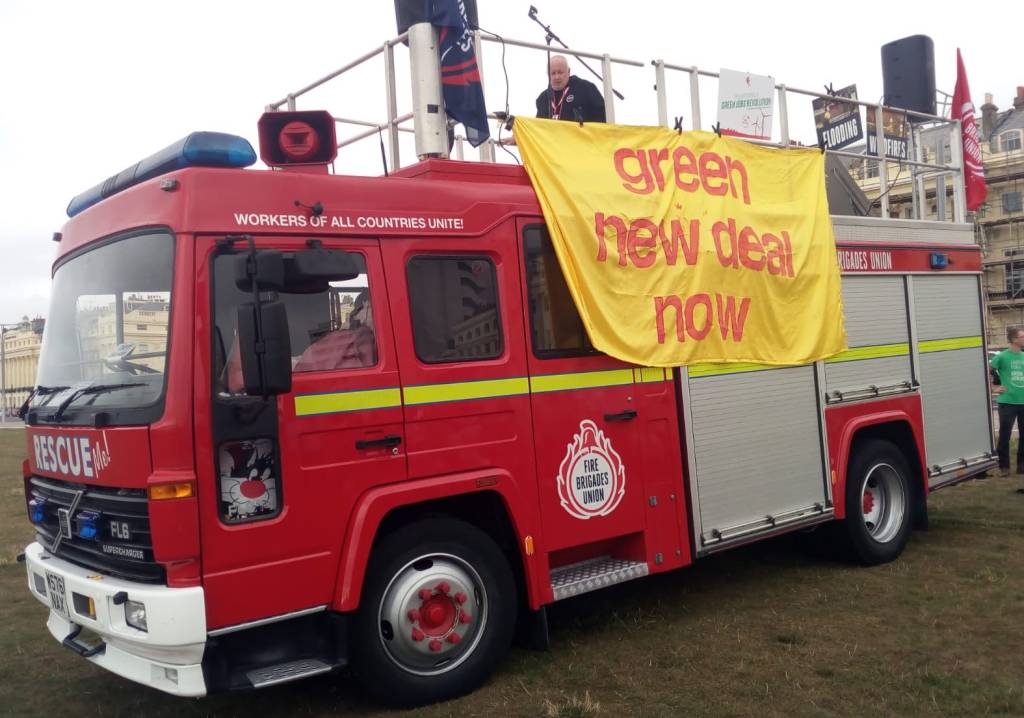
Momentum members voted for public ownership of the banks. So why is Momentum calling for “regulation”?

By Mohan Sen

In April members of Labour left organisation Momentum voted in a “policy primary” for motions to promote for this year’s Labour Party conference. Two of the eight motions we decided on called for public ownership and democratic control of the banking and financial sector, to halt high finance’s social and climate vandalism and redirect its vast resources towards tackling climate change and inequality.

One of these motions (“Build back better: attack poverty and inequality”) was motivated on living standards and inequality; the other (“Global climate justice”) on climate change.

The first called for “taking banking and finance into democratic public ownership”; the second for “bringing the banking and financial system into democratic public control to fund a just transition”. (See text here, motions 3 and 6.)

As far as I can see, Momentum has done nothing to promote this crucial policy since then. Now it has put out propaganda which flatly contradicts it.

On 27 August Momentum social media put out a video with economist Grace Blakeley calling repeatedly for “regulation” of the banks to tackle climate change. The Facebook status and tweet promoting the video also call for “regulation”.

The Fire Brigades’ Union’s pamphlet It’s time to take over the banks explains very well why regulation is nowhere near enough to change the role of the financial sector.

And this review of Grace Blakeley’s book Stolen by economist Michael Roberts, who co-wrote the FBU pamphlet, aptly criticises Blakeley’s failure to call for public expropriation of the banks and high finance.

As Roberts has explained, the banks and so on are already heavily regulated. Regulation is ineffective.

By promoting “regulation” of the banks as some kind of solution, Momentum is advocating a very weak policy. In terms of climate change: not only because regulation will be ineffective in changing financial institutions’ behaviour; but also because big fossil fuel companies are not totally dependent on banks etc for their funding; and to have a serious impact we need to actively take hold of the sector’s resources and leverage and use them for positive environmental and social action.

Momentum refers fairly frequently to “socialism”. What does this mean if it is not willing to advocate policies like taking the banks into public ownership, which in fact are a long way short of replacing capitalism with socialism?

At the same time, Momentum – despite its leaders’ rhetoric about “democratising” the organisation – is ignoring policy voted for by its members, in a vote it championed as a great exercise in democratic membership decision-making.

Did Momentum’s National Coordinating Group, or some sub-group of it, decide to put out the weak gruel about “regulation”, in defiance of the policy agreed by members – or was it the Momentum office without regards to the NCG?

We hear a lot from Momentum about “democracy” and “socialist policies”. Momentum leaders who take these things seriously should insist the organisation corrects course and starts calling publicly for public ownership and democratic control of finance. Momentum members who take these things seriously should demand this change.

Afghan refugees – model motion

Let us know if you’ve passed the motion or if you need help: team@momentuminternationalists.org

We call on the leaders of the labour movement to campaign for an open door for refugees from Afghanistan.

We will mobilise to support protests for better rights for those refugees.

We condemn the government’s handling of the Afghanistan refugee crisis.

We call for:

  1. Immediate asylum for Afghans already waiting for status in the UK.
  2. Release Afghan refugees from detention. Close the detention centres.
  3. Scrap the Nationality and Borders Bill that criminalises and denies full refugee status to those who make their own journeys to seek asylum in the UK.
  4. Full support for international efforts to evacuate and resettle Afghan nationals.

See also https://www.jcwi.org.uk/stand-with-afghan-refugees

Public ownership of the banks – model motion

Let us know if you’ve passed the motion or if you need help: team@momentuminternationalists.org

Notes:
1. The stark warning from the UN Intergovernmental Panel on Climate Change (IPCC), and the need for extremely radical changes to meet this emergency.
2. The role of big banks and financial institutions in funding fossil fuels and other environmentally damaging industries. The world’s top 60 banks have provided £3.8trillion for fossil-fuel companies since the 2015 Paris climate deal.
3. That UK bank Barclays was the seventh worst, and the worst among European banks.
4. That in 2019 the City of London provided loans and investments for companies and projects that emitted 805m tonnes of CO2, 1.8 times UK net emissions.

Further notes:
1. That banks and financial institutions play a deeply antisocial role – aiding and encouraging corporate environmental and social vandalism while enriching their bankers and top officials, sacking workers, and closing branches.
2. That in 2008 UK-based banks were bailed out with hundreds of billions and facilitated to carry on as before, at working people’s expense.
3. That in 2012 and 2019 TUC Congress passed resolutions from the Fire Brigades Union calling for the big banks and financial institutions to be taken into democratic public ownership, to create a public banking, pensions and mortgage system – allowing their vast resources to be shifted from fuelling emissions and making the richer richer to combatting climate change, tackling inequality and providing good jobs, services and housing. The policy conference of Unite, the largest finance sector union, has passed similar.

Resolves
1. To call for unions to actively campaign for this policy, and for Labour to adopt and campaign for it.
2. To circulate the FBU’s pamphlet “It’s Time to Take Over the Banks” (www.fbu.org.uk/publication/its-time-take-over-banks)
3. To host a public discussion, inviting an FBU representative, and economist Michael Roberts, who wrote the pamphlet.

Defend teachers and union rights in HK!

By Pete Radcliff

The Chinese Communist Party (CCP) has now opened up an attack on the very existence of independent trade unions in Hong Kong.

On Saturday 31 July, the main Hong Kong teachers’ union, the HKPTU, was accused by the Communist Party and Chinese state media (People’s Daily and Xinhua) of being a “malignant tumour” that needed to be “eradicated”. A couple of hours later, the Education Department of the Hong Kong government announced it had broken off all relations with the HKPTU, refusing to talk with them – in effect withdrawing recognition. On 10 August, after a series of retreats, the HKPTU disbanded.

The regime has already made large protests or assemblies illegal, threatening renewals of the 2019/20 democracy protests with the National Security Law (NSL) and possible life sentences. On Friday 30 July, 24 year old Tong Ying-kit was given a nine-year prison sentence, six and a half years of which was for flying a flag saying “Liberate Hong Kong”, the first conviction under the NSL.

They have demanded oaths of loyalty to the regime from public sector workers. They have imprisoned some journalists, intimidated others, and forced the closure of some of the oppositional press. The regime’s courts have defined the major slogan of those protests “Liberate Hong Kong: Revolution Now” as incitement to secede illegal under the NSL.

Leading activists of the democracy movement are in jail awaiting trial on NSL charges of subversion for trying to win the 2020 elections. Even the broadest and most moderate groups such as the Hong Kong Alliance and the Civil Human Rights Front have had their leaders arrested and charged under the NSL.

Leaders of the Hong Kong Confederation of Trade Unions (HKCTU) such as Lee Cheuk Yan and Carol Ng have been jailed. The move against the HKPTU is the first against the very existence of the independent trade union movement. The HKCTU emerged in 1990 to challenge the pro-Beijing HK Federation of Trade Unions (HKFTU), and includes new unions set up in late 2019.

The HKPTU is the largest of the HKCTU’s affiliates, with about 96,000 members. Most of its members work in schools, a few in universities. And of the 10,200 arrested by the police in the 2019-20 democracy protests, 42% were students.

The pro-CCP authorities say that teachers were fomenting the dissent. Squashing dissent in schools is now the government’s highest priority.

Three teachers known to have been involved in the protest movement had already been sacked. In May 2021 respect for the NSL was made mandatory in the Economics, History and Social Studies curriculum.

Teachers objected to this pro-National Security Law curriculum being forced on children as young as six years old.

However the main charge made against the HKPTU, at least in the Education Department statement declaring derecognition, was their involvement in the Civil Human Rights Front and the Hong Kong Alliance. Most of the activists of both of these broad and generally moderate campaigns have been arrested for their role in protests.

Sadly, the HKPTU has responded to the attacks by retreating. On 29 July, the HKPTU withdrew from the Hong Kong Alliance and also declared that it had always opposed independence for Hong Kong. It pulled out from the HKCTU and from the Educational International union grouping. It declared that it was withdrawing from political involvement and would concentrate on welfare work for its members. On 7 Aug, HK Education Secretary Kevin Yeung issued an open letter to Hong Kong teachers calling on them to resign from the union. On the same day, the HKPTU announced a working group to promote a “positive understanding” of Chinese history and students’ love of “their country”. Then on 10 Aug the HKPTU disbanded.

The attack on the HKPTU is a threat to the whole independent trade union movement in Hong Kong. Despite the ongoing repression and the arrest of their leaders, the HKCTU has bravely continued to function – representing workers against the repression and against bosses’ intimidation too.

The Labour Movement Solidarity with Hong Kong campaign has issued a statement (bit.ly/hk-ptu) signed by three UK union general secretaries and over 150 other trade unionists. We demand a reversal of the HKPTU’s derecognition. Teachers and students must be able to challenge the curriculum and education system that the CCP would like to impose on them. We support the HKCTU against the further attacks now likely.

The Hong Kong independent unions are the only legal ones in the territories ruled by the CCP. They are a beacon of hope for workers in China, where the only union allowed is the state-controlled ACFTU, whose primary role in to police the workers rather than organise them to fight back. The National Security Law, with its xenophobic curbs on “collusion with foreign forces” is now being used to stop unions in Hong Kong making contact and requesting international solidarity.
Hong Kong trade unionists can’t speak out on this without facing arrest. That makes it even more important for unions and activists in Britain and elsewhere to speak out, working with the growing Hong Kong diaspora here.

Rally the left for Labour party conference

By Michael Elms

Many Constituency Labour Parties (CLPs) are yet to decide their motions to Labour Party conference (25-29 September in Brighton) at meetings in August or more likely in early September. Many will have decided in July, and rule-change proposals were in by 11 June.

Momentum Internationalists were pleased that our own Build Back Fairer motion was backed by Momentum, about a plan for rebuilding the workers’ movement and society on a more equal basis in the pandemic and its wake. You can buy a pamphlet which expands on those ideas here .

There are several left-wing rule-change proposals: the two main ones on the order paper, so we hear, are for removing the “three-year rule” which blocks CLPs (but not the National Executive) from reopening rulebook issues within three years, and for accountability of the Parliamentary Labour Party to Labour conference.

For Starmer, the conference will be a test of his planned “relaunch” following universal criticism and poor performance this year. For the left it will be an opportunity to regroup politically and begin plans to rebuild – to rebuild a functioning left in Labour, but also to present a left-wing, alternative plan for rebuilding society in Covid times.

Since January 2020 Labour Party membership has gone down by 120,000 to about 430,000, the same figure as in November 2019. Anecdotally, many left-wingers have quit, and others are keeping their heads down in CLPs.

At the London Labour conference on 24-25 July, pro-Starmer candidates from the right-wing “Labour to Win” faction swept the elections for the regional board. We can expect that this rightward shift will also be reflected in the delegates being sent to conference. The crop of left-wing motions being sent appears to be much thinner this year, so far, than it was in 2019 (which was a left-wing high tide).

That doesn’t mean that Labour has simply been retaken by the right. The 430,000 membership is still more than double what it was in May 2015. Starmer’s attempted purge of hundreds of members of groups like Socialist Appeal and Labour Against the Witch Hunt, while outrageous and potentially demoralising, is unlikely to change this.

Opinion among the membership is still comfortably to the left of Starmer. While the London regional conference elections went to the right, motions were passed endorsing the 2019 manifesto’s “free broadband” pledge and calling for Transport for London to bring all of its staff and services back in-house. A motion on Just Transition and the climate crisis passed in spite of opposition from Unite and GMB delegates, who took issue with the motion’s call to end airport expansion.

Starmer’s recent policy announcements (really, re-launches of Corbyn era policies) on workers’ rights, including a pledge of worker status for spuriously self-employed gig economy workers, may be in part a recognition of this diffuse left-wing mood.

The left-wing party membership is poorly organised and still disoriented politically. Momentum nationally has been largely inactive this year. A bad, ultra-suspicious political culture and disdain for democracy hobbled the organisation for most of the Corbyn period. The new Momentum leadership elected in 2020 promised more democracy but has failed so far to reinvigorate local Momentum groups, in part because it has continued much of the top-down, office-led, NGO-style outlook of the previous administration; its “new strategy” document sheds little light.

Even given all the real difficulties, Momentum’s performance at getting its own recommended motions passed by CLPs looks poor thus far.

PR yes, “Progressive alliance”, no

By Michael Elms

In the run-up to Labour Party conference on 25-29 September, one area where the left (and the Labour right, too) remains split is on the question of Proportional Representation. There has been a major organised push to get PR motions on the conference order paper this year.

Some on the Labour left oppose PR on the grounds that it would make the process of getting a Labour government more complicated, and that the whole idea is often packaged with support for a “progressive alliance”, some sort of electoral non-aggression pact between Labour, the Lib Dems, the Greens, Plaid Cymru and the SNP.

In a 5 August interview with the Financial Times, Starmer dismisses electoral pacts out of hand. Much as such a pact would drag Labour further right, he seems to calculate that promoting it now would only help Labour votes leak to other parties.

A minority Labour government might well find itself relying on the votes of other parties: but making a deal with them, rather than challenging them to back Labour or face a new election, could only have the effect of letting anti-working-class or nationalist parties dictate Labour policy, or giving Labour right-wingers a lever to prevail.

But if it can be separated from the question of a “progressive alliance”, the left has to support PR. The reason is simple: PR is a more democratic voting system than First Past the Post. Even if it is the case that a better voting system would complicate Labour’s path to forming a government, that is not sufficient grounds to oppose PR.

A reasonable person could see that the left only supports democracy “when it suits them”.

Any weakening of socialists’ principled and absolute support for democracy as a good in itself will ultimately hollow out and weaken the workers’ movement, which needs democracy like oxygen.

To tame Covid, combat inequality

By Martin Thomas

Over the longer term, several studies suggest that the biggest factor reducing Covid toll so far has been lower income inequality. In separate studies Annabel Tan and others, and Tim Liao and others have found that for US counties; Carlos Oronce and others and Youyang Gu, for US states; Frank Elgar and others, for countries (among 84 that they studied).

There are obviously many other factors: vaccines, of course, and judicious lockdowns and quarantines which can usefully slow (but on all evidence, not end) Covid spread. Hospitals get less swamped, and, in the meantime, more people get vaccinated.

Israel, Malta, and the Seychelles have all had new Covid surges after widespread vaccination (Seychelles surge centred in June, Malta’s in July, Israel ongoing). That makes it likely that Britain will have new surges too. On the evidence of Israel and Malta, the death rates in new surges will be, not zero, but lower than before widespread vaccination. (The UK’s Covid case fatality rate is now about a tenth of what it was in early 2021, and comparable with the CFR for flu, though Delta-variant Covid spreads much quicker, and more pre-symptoms, than flu).

Israel is giving third booster jabs to all over-60s, with the experts there arguing that they don’t know what difference that will make, but in any case the experiment will give evidence for other countries to go by. Seychelles had a high death rate in its recent surge, which may be down to it using the less effective of the two main Chinese vaccines.

Long term

A discussion of longer-term prospects by Amalio Telenti and others suggests Covid may evolve into a disease which almost everyone gets from time to time, from childhood on, mostly mildly, and with a broadening immunity which can keep pace with variants until old age, when constantly-updated vaccines can protect. But we don’t know, and even if Telenti is right, we don’t know whether it will take only a few years, or many decades, for Covid to evolve that way.

New trials by the WHO and by the UK Recovery project are starting on treatments for Covid, but results are likely to be incremental rather than drastic.

The labour movement needs to keep pushing for the social measures which can transmit into lower income equality and blunt the inevitable Covid surges. Full isolation pay and secure jobs for all. Workers’ control of workplace safety. Affordable uncrowded housing for all. Social care under public ownership and with workers on NHS-level pay and conditions. Fund the NHS to create increased capacity and better conditions for workers and patients.

And for public ownership of Big Pharma, to make patent information and production technologies available worldwide for a full-speed drive to vaccinate worldwide. Worldwide, Covid deaths are still trending up. The world vaccination rate is now up to 0.5 jabs per 100 people per day, but Africa is still on less than 0.1 per 100 per day.

Isolation pay in test centres: plug the loopholes!

By Todd Hamer

Following pressure from Labour MPs, notably Emily Thornberry, and the Safe and Equal campaign last winter, we were told that “the Department of Health and Social Care has approved the payment of occupational sick pay for periods of self-isolation for all workers at Test Centres. This commitment has also been included in the tender specifications for the new Test Centre contract which commences in July 2021.”

As Safe and Equal activists have visited Test Centres across the country, we have found that the situation is more complicated. The government has outsourced the Test Centres to G4S, Serco, Sodexo, Mitie. But those firms have often further outsourced staffing their Test Centres to agencies.

The workers directly employed by the main contractors may get isolation pay; but many workers we have talked with are employed via agencies on zero hours contracts. Some were unsure about the pay arrangements if they had to take time off to isolate. Others told us that they got paid to isolate if they could provide evidence of a positive test but not for other reasons e.g. a member of their household was ill.

One worker was sent home to isolate due to being a close contact of a confirmed positive case and was not paid for this time.

In March 2020, NHS bosses were told they needed to arrange full isolation pay for subcontractors and bank staff. In May 2020, the PCS union negotiated full isolation pay for outsourced workers operating in civil service buildings. In June 2020, the government introduced the Infection Control Fund for care homes that included provision for full isolation pay for care workers.

The new on-paper agreement for full isolation pay for Test Centre workers is a further admission that exploitative employment practices and the UK’s desultory Statutory Sick Pay scheme are undermining attempts to control the virus. However, instead of addressing the problem at its root and legislating to ensure all workers are entitled to full sick pay (as in many European countries), the government has introduced sector-by-sector isolation pay quietly and half-heartedly, leaving plenty of workers excluded from the provision.

Part of the issue here is that the work-from-home boss class believe that paying workers to take time off to isolate will encourage absenteeism. In reality, “presenteeism” is a far greater problem. Workers attending work when they are unwell allows all sorts of infectious diseases to spread and accidents to occur.

Head of Test and Trace, Dido Harding told Emily Thornberry MP that she was “making changes to increase the financial support available to staff during periods of isolation” in recognition of the “immense contribution” of frontline Test Centre workers. But sick pay and isolation pay are not rewards for hard work: they are necessary health and safety measure to slow the spread of the virus.